Will There Be a Big Decline in Population After Baby Boomers Pass Away
What Will Happen to Housing When the Baby Boomers are Gone?
Every bit babe boomers historic period and die, adult population growth will begin to fall off sharply in the coming decade. Though this pass up volition have a dampening effect on household growth, it will occur over several decades and much may be offset by the millennial generation beginning households of their own. Even when baby boomers practise release housing back into the market, it may non exist suitable for, or desired by, younger occupants, so despite slower adult population growth in the future, demand for newly built housing volition persist.
Co-ordinate to contempo Census Bureau population projections, adult population growth will kickoff turning sharply downward later this decade (Figure 1). Later on increasing by close to 2.5 one thousand thousand each twelvemonth for more than than a decade, growth in the population age 20 and older will steadily reject to about 1.5 million per yr past 2050, a forty percent drop.

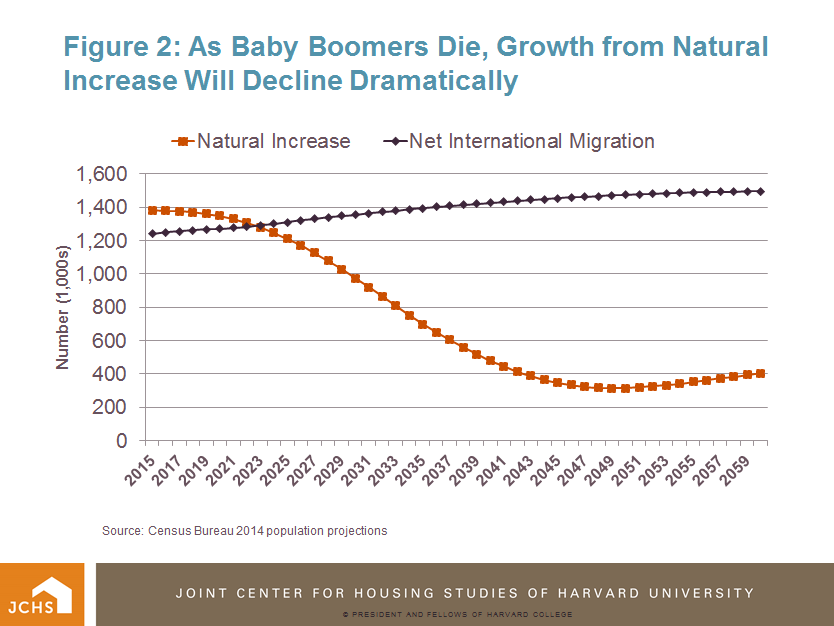
Despite their improving life expectancies, the oldest infant boomers will soon plough 70, and begin to die off in ever-greater numbers. Today, at that place are about 2.half-dozen million deaths every year, but this number will rise to over 4 one thousand thousand a yr by 2050. Meanwhile, births are also projected to increase over the same time period, but but by about 500,000. Consequently, the rate of natural increment (births minus deaths) is projected to autumn dramatically (Effigy 2). Today, population growth is most evenly distributed between migration from abroad and natural increase. Under the new Census Bureau assumptions, natural increase will autumn to half the level of growth from immigration by 2035, and further decline to about one third by 2050.
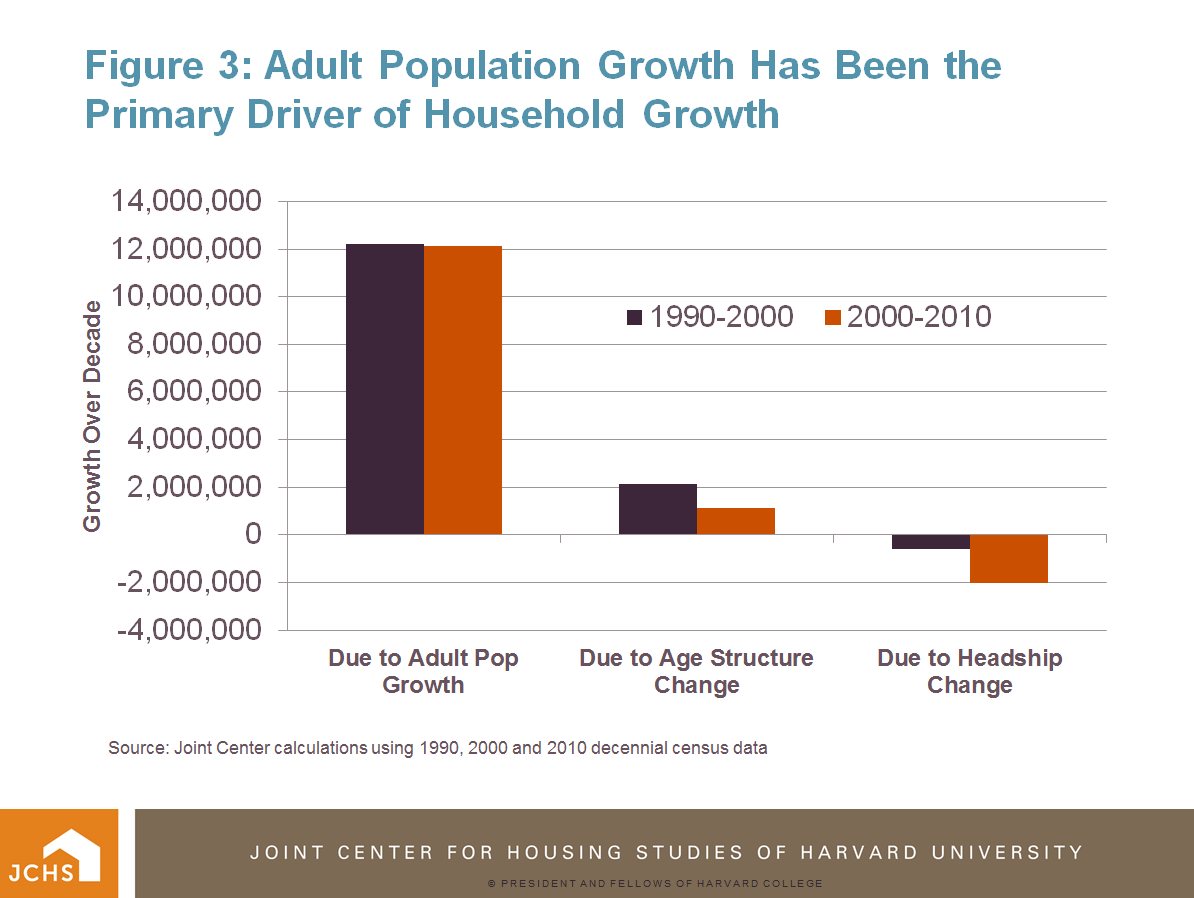
Adult population growth has more often than not been the primary commuter of household growth in the U.Southward. For most years since 1990, there have been roughly 2.v million more adults over the age of 20 compared to the yr earlier. This growth came from the crumbling of those born in the U.S. 20+ years ago, also as clearing during the past two and a half decades. On average, virtually half of all persons over the age of xx head an independent household. Therefore, the developed population growth we've seen over the past 25 years alone would business relationship for annual household growth of well-nigh 1.ii 1000000.
Actual annual household growth was either above or below i.2 million because of shifts in the age structure of the developed population, and considering of changes in historic period-specific rates of household formation (headship) linked to social, demographic, and economic changes. These latter changes include trends in marital status and fertility, minority composition and nascence, and employment and income, to name the near important.
Age structure changes have had a positive effect on household growth as crumbling baby boomers inflated successive historic period groups that have higher headship rates. For instance, the oldest boomers were age 35-44 in 1990, 45-54 in 2000 and 55-64 in 2010. As they aged, the share heading an independent household increased from 53.4 pct in 1990, 56.ane percent in 2000, and 58.5 per centum in 2010. On the other hand, recent social, demographic, and economical trends have generally had a negative effect on age-specific rates of household formation, particularly in the younger age groups. Higher minority shares and delayed marriage have had a negative event on headship rates, as has the Corking Recession'southward bear upon on employment and income. Information technology is important to notation, withal, that non but have the effects of population aging and the broad demographic trends affecting headship rates tended to cancel each other out, but each has been small compared to that of adult population growth, numbering in the low hundreds of thousands almanac net household growth or decline (Figure 3).
Projected declining adult population growth because of increasing deaths will have several effects on housing markets, mentioned beneath. Merely information technology volition not have an immediate and proportional impact on household growth for a variety of reasons. First, many initial baby boomer deaths will occur to married couples, leaving the surviving spouse to continue to head a household. Many deaths will too occur to people who exercise not head a household, but rather live in a household headed by children or other relatives, or in institutional settings (assisted living or nursing facilities). Failing household growth because of increased household dissolutions among the elderly will be spread out over many decades. Furthermore, when dying baby boomers exercise begin to have a larger bear upon on full net household growth, aging millennials could cause the irresolute age structure upshot to be more positive, similar to what babe boomers exerted every bit they passed into middle historic period, offsetting the effects of declining adult population growth. It is also entirely possible that a fuller recovery from the Corking Recession volition reverse the fall in headship rates, further offsetting whatsoever effect of slower adult population growth.
When we reach a point where baby boomers are releasing housing in greater numbers back to the marketplace, notwithstanding, we still cannot assume that information technology will proportionately reduce the demand for newly congenital housing to accommodate young adults. Many homes vacated by crumbling seniors volition non be in demand by tomorrow'south young adults, being in the wrong function of the country or otherwise unsuitable (age restricted communities, for example). Some will be merely too expensive. Some "affordable" vacated homes in desirable locations will be torn down and replaced past larger and more free energy efficient / amenity rich houses targeted to older buyers. Many houses will sit on the market for long periods of time before sellers are willing to recognize that they are overpriced. Some homes in declining communities will become abandoned.
In short, while the housing market does somewhat resemble a game of musical chairs, with successive age groups "moving upwardly" as their incomes and families grow, and older households exiting, this process tin be inefficient for immature adults moving into units vacated by baby boomers because of the reasons discussed. In addition, the majority of infant boom household dissolutions volition non take identify until after 2030. It will non be until 2060 or later that the last of the baby boomers, born in the early 1960s, volition die. Between now and 2030, new construction will still be needed to run across the housing demand from the big cohorts under the age of 30 that are currently in the pipeline, and which will be further inflated by whatsoever hereafter immigration. Where that housing will be located and what it will expect like is far less sure.
Will There Be a Big Decline in Population After Baby Boomers Pass Away
Source: https://www.jchs.harvard.edu/blog/what-will-happen-to-housing-when-the-baby-boomers-are-gone
0 Response to "Will There Be a Big Decline in Population After Baby Boomers Pass Away"
Post a Comment